
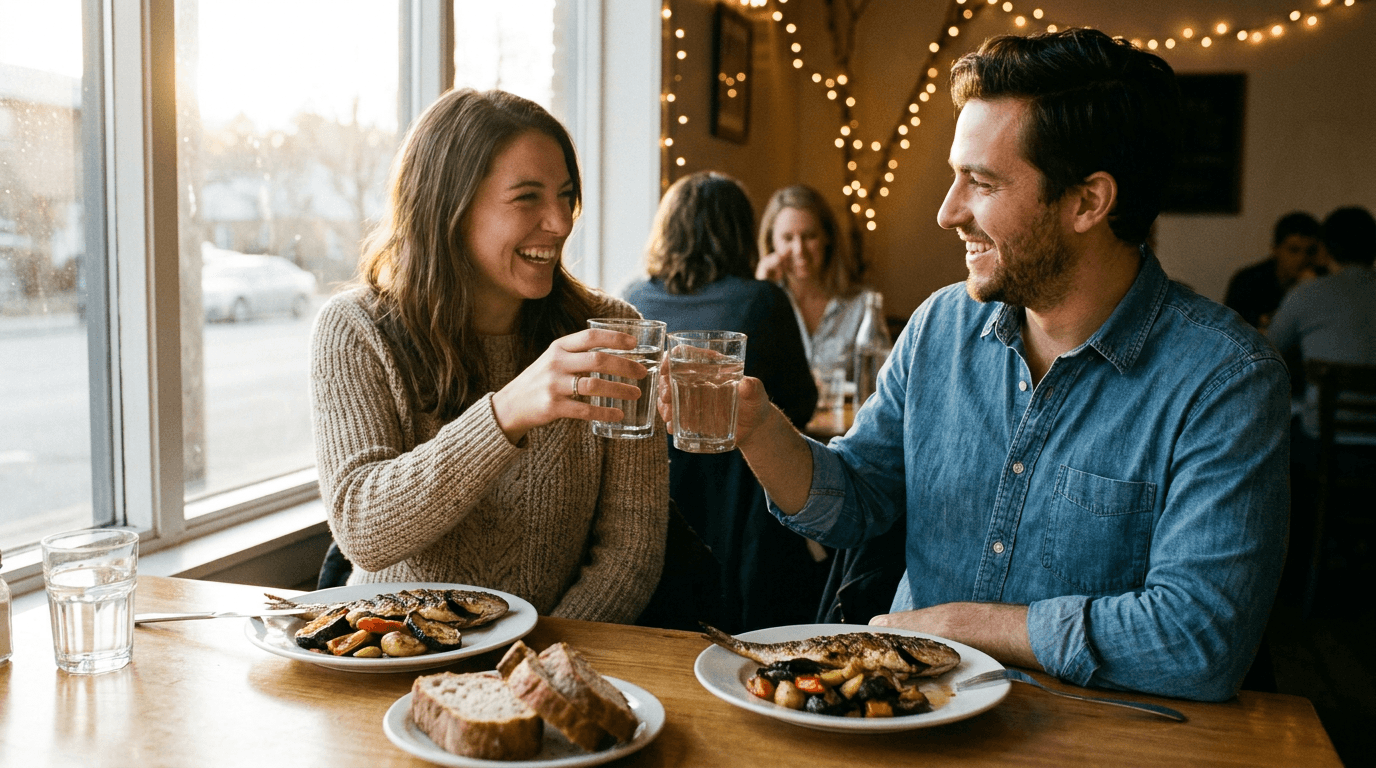
You know the feeling before you've even left the house. A friend texts a restaurant name, and instead of excitement, you feel a small knot of calculation: Where's the bathroom there? What can I actually eat? Will I be doubled over by dessert? For a lot of people with IBS, eating out stops being a pleasure and starts being a risk assessment. And when a meal you didn't cook does trigger a flare, it can feel like proof that your world is shrinking one dinner reservation at a time.
Here's what we want you to hold onto from the very first line: this is not about willpower or being difficult. Restaurants are genuinely harder on a sensitive gut than your own kitchen, for reasons that have nothing to do with you being "fussy." Once you understand why eating out flares IBS, you can build a playbook that lets you keep your social life and your comfort. Both. Not one at the expense of the other.
Why eating out flares IBS more than home cooking
When you cook, you control every variable. A restaurant is built to do the opposite: maximize flavor, speed, and volume. Those goals quietly stack the deck against a FODMAP-sensitive gut.
Hidden onion and garlic are everywhere. This is the big one. Garlic and onion are among the most common IBS triggers, and they're also the backbone of professional cooking. They hide in stock, gravy, marinades, spice blends, dressings, and "seasoning" that never appears on the menu. You can order the plainest-looking grilled chicken and still get a garlic-heavy pan sauce you never asked for. Garlic-infused oil is usually fine, but a dish simmered with onion and garlic pieces is a different story.
Portion sizes are bigger than your gut expects. A food that's gentle in a normal serving can tip into trigger territory when the plate is twice the size you'd make at home. FODMAPs are dose-dependent, so quantity matters as much as the food itself.
FODMAP stacking sneaks up on you. This is the subtle one. Even if no single item on the table is a strong trigger, several moderate ones eaten together in one sitting can add up past your personal threshold. A little wheat bread, a creamy sauce, a few beans, a glass of wine, dessert. Individually, maybe fine. Together, a flare. Restaurant meals are practically designed to stack.
Alcohol and carbonation add fuel. Alcohol is a gut irritant and a motility disruptor for many people, and it lowers the guardrails on what you order next. Beer and certain wines also bring their own FODMAPs to the party.
None of this means you're doomed to suffer. It means the room is set up a certain way, and now you know the layout.
Cuisines that tend to be easier (and why)
No cuisine is universally "safe," but some make it far easier to build a low-FODMAP plate. Think in terms of what you can control on the plate, not national stereotypes.
- Japanese and sushi often lean on plain rice, salmon, and simple proteins. Watch soy sauce quantities and skip the garlic-heavy sides, but the base ingredients are gut-friendly.
- Grilled and steakhouse-style menus give you a plain protein plus a plain potato or rice. You can ask for the sauce on the side and dodge the onion-garlic gravy entirely.
- Mexican can work beautifully around corn tortillas, grilled meat, rice, and tomato salsa, as long as you go easy on beans and onion.
- Simple Mediterranean grills, plain fish, and rice-based dishes tend to be adaptable.
Harder-mode cuisines usually aren't off-limits either, they just need more questions: anything built on heavy onion-garlic bases, thick creamy sauces, or lots of legumes and wheat. We keep dish-by-dish ordering guides — what to order, what to modify, what to skip, and the exact questions to ask — for 15 chains and 10 cuisines in the eating-out guides.
The ordering playbook
This is where the dread turns into a routine you barely think about.
Before you go
- Read the menu online first. Deciding at home, calm and unhurried, is a hundred times easier than under pressure with a server waiting.
- Pick your anchor dish and a backup. Often it's a plain protein plus a plain starch like chicken with rice or potato.
- Eat a small, safe snack beforehand if you're worried, so you're not ordering while starving.
At the table
- Ask, kindly and specifically. "Is there onion or garlic in this sauce?" gets you further than "Is this low-FODMAP?" (most staff won't know the term). Kitchens answer concrete questions well.
- Order sauces and dressings on the side. This single move solves a huge share of hidden-trigger problems.
- Choose grilled, steamed, or roasted over saucy, braised, or "smothered."
- Mind the stack. If you want the bread basket, maybe skip the creamy pasta. Give your gut one indulgence, not four.
- Slow the alcohol down. Alternate with water, or pick a lower-FODMAP option and keep it to one.
You don't have to explain your medical history to a server. "I have some food sensitivities, can the kitchen leave the onion and garlic out?" is a complete, dignified sentence.
Damage control if a flare comes anyway
Sometimes you do everything right and your gut still revolts. That's not failure. That's IBS being IBS. Be gentle with yourself and lean on what helps:
- Stop eating the trigger once you notice, and switch to water.
- Get comfortable. Loose clothing, gentle movement or a walk, a warm compress on the belly, peppermint tea if it agrees with you.
- Give the next day some grace. Keep the following meals simple and familiar so your gut can reset.
- Log what happened. A quick note on what you ate turns a bad night into useful data instead of just a bad night.
One important boundary: an occasional flare after a rich restaurant meal is normal for IBS, but some symptoms are never just IBS. Unexplained weight loss, blood in your stool, symptoms that wake you from sleep, new digestive symptoms starting after age 50, or signs of anemia all warrant a real conversation with your doctor, not a food swap. Getting those checked isn't overreacting, it's the responsible baseline that lets you relax about the everyday stuff.
The mindset shift: your gut, not your gatekeeper
Here's the reframe that changes everything. The goal of managing IBS was never to eat perfectly. It's to understand your own body well enough that food stops feeling like a trap. The FODMAP approach is a temporary diagnostic tool, not a life sentence of restriction. If you want the full picture of how the three phases work, our guide to the low-FODMAP diet walks through it, and once you've reintroduced foods, you'll often find you tolerate more at restaurants than you feared.
Knowing your personal triggers is what buys back your social life. When you know that onion in quantity is your problem but a plain grilled salmon with rice is a safe bet, a dinner invitation stops being a threat and becomes just dinner again. If you want that knowledge in your pocket, Phase's food list lets you check any ingredient before you order, and you can scan a menu without missing a beat.
The point of all of this is not a smaller life. It's a bigger one, lived with a gut you finally understand. You can travel, say yes to the birthday dinner, order confidently, and handle the occasional off night without it derailing your week. IBS asks you to be a little more informed than the average diner. It doesn't get to decide who you eat with, or how much you laugh at the table. That part is still entirely, wonderfully yours.
If you want your triggers and safe foods in one place next time you're handed a menu, download the Phase app and take the guesswork out of eating out.