
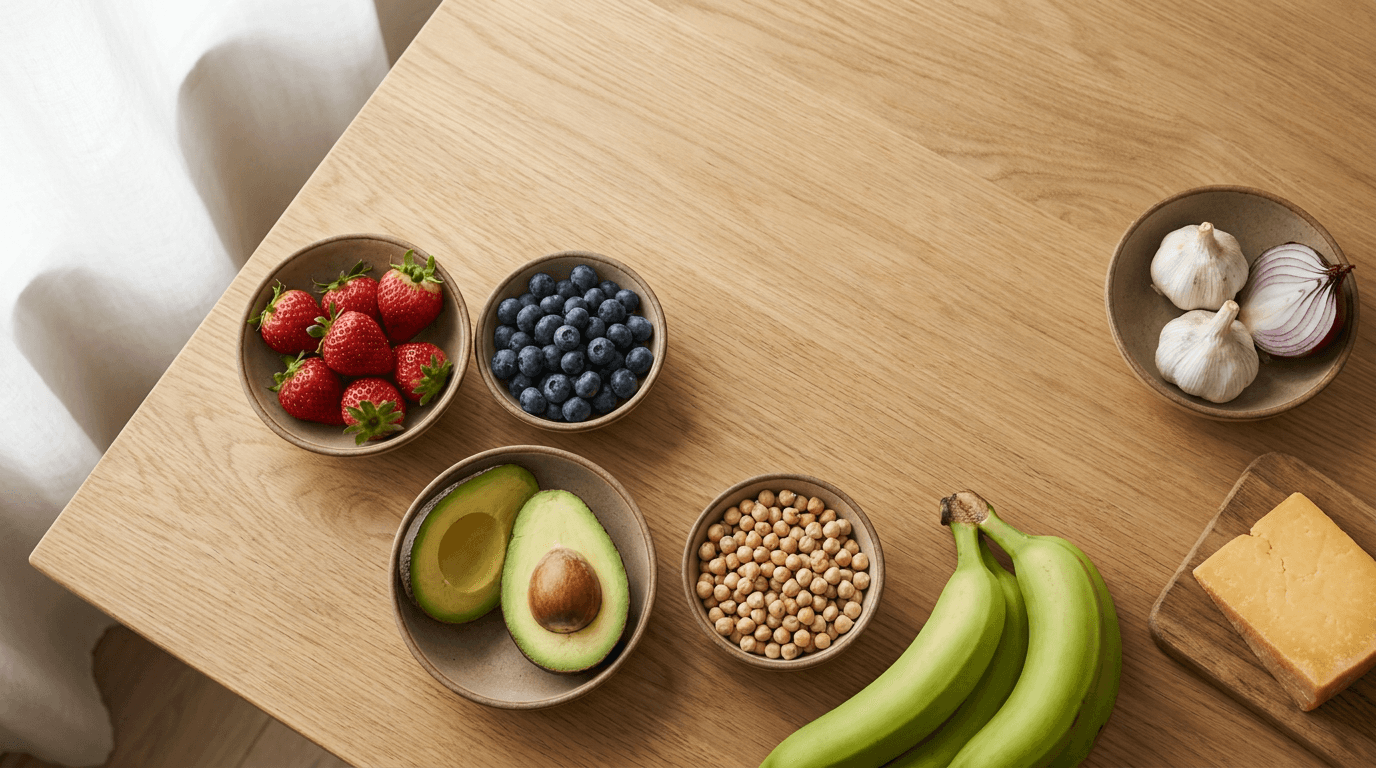
If you've just started a low-FODMAP diet, the first question is almost always the same: which high-FODMAP foods to avoid while your gut settles? The honest answer is that "avoid" isn't quite the right word. During the elimination phase you're limiting certain foods for two to six weeks, not banning them for life. The goal is to quiet your symptoms enough to see clearly, then add foods back one group at a time.
This guide walks through the main high-FODMAP foods to limit, grouped by the five FODMAP types so you can spot patterns instead of memorizing a giant list. For any specific food and portion, you can always check the exact threshold on the food database or read the full low-FODMAP diet guide first.
First, what "high-FODMAP" actually means
FODMAP stands for Fermentable Oligosaccharides, Disaccharides, Monosaccharides, and Polyols — short-chain carbs that some guts absorb poorly. When they reach the large intestine undigested, bacteria ferment them, drawing in water and producing gas. For people with IBS, that can mean bloating, cramping, urgency, or constipation.
Two things matter more than any single food. First, dose. Many foods are perfectly fine in a small serving and only become a problem in a large one. Second, this is temporary. You're building a short baseline, not a permanent rulebook.
Fructans (oligosaccharides) — the big ones
Fructans are the most common trigger and the hardest to avoid because they hide everywhere. This group includes wheat, rye, and — the two heavyweights — garlic and onion. Both are high even in tiny amounts, which is why they're the first foods most people pull.
Watch for the sneaky sources. Garlic powder and onion powder turn up in stock cubes, spice blends, sauces, chips, and "natural flavoring." A stir-fry that looks low-FODMAP can still be loaded through the seasoning. Garlic bread is an obvious one to skip early on. Cooking without them is easier than it sounds — see the onion substitutes and garlic substitutes guides.
Wheat is the other big fructan source. Wheat bread and wholemeal wheat bread are limited during elimination, though the load is about quantity — a small amount affects people differently than a large sandwich.
| Limit during elimination | Lower-FODMAP swap |
|---|---|
| Garlic, onion, their powders | Garlic-infused oil, chives, green scallion tips |
| Wheat and rye bread | Sourdough spelt, oats, corn or rice-based breads |
| Garlic bread | Plain toast with garlic-infused oil |
GOS (galacto-oligosaccharides) — mostly legumes and some nuts
GOS lives in beans, lentils, and a few nuts. Most canned legumes are high in a normal serving, including chickpeas, black beans, and kidney beans. Rinsing canned beans well and sticking to a small portion helps, because some GOS leaches into the liquid — but during a strict elimination it's simpler to limit them.
On the nut side, cashews are notably high in GOS, and so are pistachios. Not all nuts are a problem, though — macadamia, walnuts, and pecans tend to sit lower and can work in modest amounts.
Lactose (disaccharides) — dose-dependent dairy
Lactose is the sugar in regular dairy, and tolerance varies a lot from person to person. The higher-lactose foods to limit include cow's milk, regular Greek yogurt, ricotta, and cream cheese.
Good news: plenty of dairy is naturally low in lactose. Hard, aged cheeses like cheddar and parmesan contain very little, and lactose-free milk lets you keep dairy in your routine. Lactose is a disaccharide, not a fructan or polyol, so if dairy is your only trigger you may find the rest of the diet fairly relaxed.
Excess fructose (monosaccharides) — fruit and sweeteners
Some foods contain more fructose than glucose, and that imbalance is what makes them hard to absorb. Common culprits are apple, pear, mango, and watermelon, plus sweeteners like honey and agave syrup.
Fruit is where dose really shows its hand. A whole mango is high, but a small amount of many fruits is fine, and low-fructose options like strawberry, blueberries, kiwifruit, and firm banana give you variety without the load. For sweetening, maple syrup and table sugar are balanced in glucose and fructose, so they behave better than honey.
Polyols — sugar alcohols in fruit, veg, and "sugar-free" products
Polyols are sorbitol and mannitol, found naturally in some produce and added to many sugar-free products. High-polyol foods to limit include apricot, peach, plum, cauliflower, and mushrooms. Avocado is high in a large serving, though a couple of slices is usually fine.
The hidden source here is anything labeled "sugar-free" or "no added sugar." Chewing gum, mints, and diet products often use sorbitol and xylitol as sweeteners, and these can trigger symptoms in surprisingly small amounts. If you've been chewing gum all day, that alone could be part of the picture. There's a full field guide to these label traps in hidden FODMAPs on labels.
Remember: limit, not forever
This is the part that gets lost. Elimination is a diagnostic step, not the destination. Once your symptoms calm down, you move into reintroduction — testing one FODMAP group at a time to learn which ones you actually react to, and how much you can handle. Most people discover they tolerate far more than the elimination list suggests. You might be sensitive to fructans but completely fine with lactose, or the reverse.
That personalization is the whole point. A permanently restrictive diet isn't healthy or necessary, and cutting foods you don't react to just makes eating harder for no benefit. IBS management is about finding the widest diet your gut tolerates — not the narrowest.
A few practical habits make elimination smoother:
- Read labels for onion and garlic powder — they're the most common hidden fructans.
- Think in portions, not bans — a small serving of a "high" food is often fine.
- Keep it short — two to six weeks is enough; longer isn't better.
- Work with a dietitian if you can, especially if your symptoms are severe or you have other health conditions.
Where to check any food
No one memorizes every threshold, and you don't need to. When you're unsure whether a food or portion is in bounds, look it up — Phase shows the serving thresholds with the research behind them, logs your meals, and helps you spot your personal triggers during reintroduction. Get started with the app and let it do the remembering for you.